Most individuals pay a significant amount of their income tax through source deductions, which are amounts withheld from their income. Employers deduct and remit income tax on a taxpayer’s behalf throughout the year with each paycheque. However, many newly retired or self-employed individuals are surprised to learn that they must make quarterly instalment payments, since retirement or self-employed income is often received without tax withheld at source.
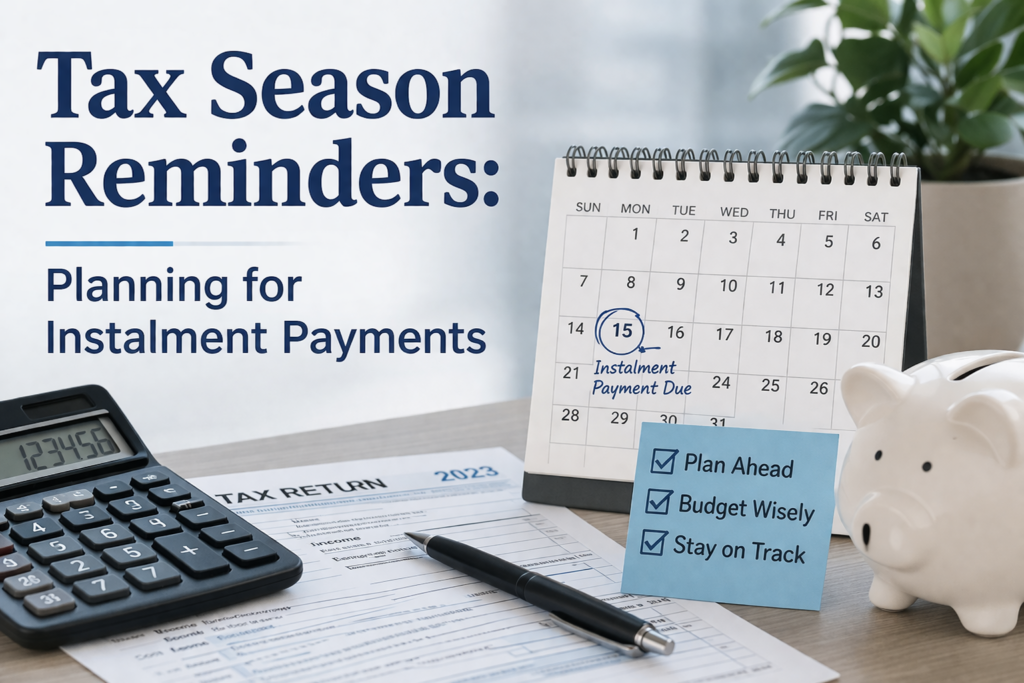
If your net tax owing is more than $3,000 ($1,800 for Quebec) in the current year and in either of the two preceding years, you generally must make instalment payments by March 15, June 15, September 15 and December 15 (with exceptions for farmers and fishers).
Planning Ahead Is Important
Planning ensures you have sufficient cash flow to meet each quarterly payment and avoid interest or penalties. Interest on late or insufficient instalments compounds daily (for Q2 2026, the prescribed rate is 7 percent federally), and penalties may apply if total instalment interest exceeds $1,000.
If your income varies from year to year, planning allows you to adjust instalments to avoid overpaying, which is effectively giving the government an interest-free loan. For example, a large one-time capital gain, such as from selling a vacation home, might cause government-suggested instalments (based on your most recent assessed tax return) to exceed what your expected income would warrant in the following year.
Three Practical Tips
Here are three practical tips to consider if you are managing instalment payments:
- Overpay when needed. If you’ve forgotten an instalment payment, you can reduce or eliminate accrued interest by overpaying subsequent instalments or making payments early. Early instalment payments earn instalment credit interest, which is not refundable but can offset interest charged on late instalments in the same year.
- Choose your calculation method. Instalments may be based on government-calculated amounts, your prior-year tax return or your current-year income estimates. Selecting the appropriate method is particularly important if your income fluctuates, ensuring you pay enough without overpaying (providing a tax-free loan).
- Adjust withholdings, if possible. Instalments can sometimes be reduced or eliminated by having tax withheld at source, or by increasing the amount withheld from OAS, CPP/QPP benefits, EI or employer-sponsored pension income. Requests must be made through Service Canada or Retraite Québec (QC). Note: tax cannot be withheld from certain types of income, including self-employment, investment and rental income or capital gains.
The comments contained herein are a general discussion of certain issues intended as general information only and should not be relied upon as tax or legal advice. Please obtain independent professional advice, in the context of your particular circumstances. This newsletter was written, designed and produced by J. Hirasawa & Associates for the benefit of Chuck Magyar who is a Portfolio Manager for iA Private Wealth and does not necessarily reflect the opinion of iA Private Wealth.